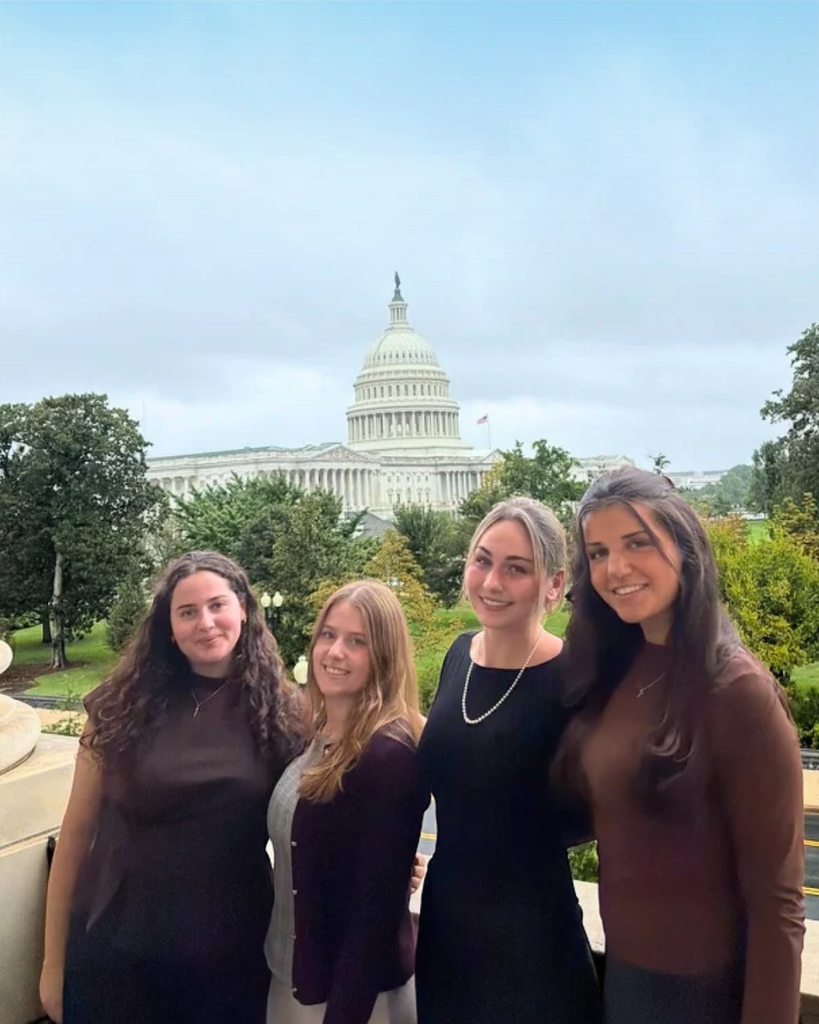
This September, our team traveled to Capitol Hill with a clear mission: meet with congressional offices and advocate for two of BCPP’s policy priorities, the No Toxic Chemicals in Food Packaging Act of 2026 and the Safer Beauty Bill Package. Both share the same goal: removing toxic chemicals from the products we rely on every day and centering prevention in policy.
We walked into every meeting with a crucial reminder: breast cancer is not a partisan issue. One in eight women in the U.S. will be diagnosed with breast cancer in their lifetime, yet under 10% of those diagnoses can be explained by family history. This draws attention to the products and environments we encounter daily, along with the exposures they bring. Exposure to these chemicals affects people in every community, regardless of party or ideology. As cancer rates continue to rise, we need precautionary, prevention-first action: safer products, stronger protections, and real accountability across the marketplace. These bills can make that happen. That’s why we went to Washington.
Who we met and how we prepared
Our executive board at Protect Our Breasts is largely made up of New Englanders, including many Massachusetts constituents, so we intentionally met with staff from the offices of Rep. Jim McGovern (MA-02), Rep. Lori Trahan (MA-03), Rep. Ayanna Pressley (MA-07), Rep. Chellie Pingree (ME-01), Rep. Rosa DeLauro (CT-03), and Sen. Ed Markey (MA). Meeting the congressional offices that represent us made our conversations personal.
Before stepping into any of these offices, we prepared. We connected with Nancy Buermeyer, BCPP’s Director of Program and Policy, and the team at the Raben Group, who walked us through the foundations of lobbying: how it works on the Hill, but most importantly, how to turn our passion for environmental health and breast cancer prevention into a clear, effective ask. Together, we also discussed the legislative history and broader legislative context for both the No Toxic Chemicals in Food Packaging Act of 2026 and the Safer Beauty Bill Package. That grounding helped us explain our asks with confidence and anticipate the questions staff might raise.
Every congressional office has their own perspective on environmental health through their constituents and history. Rather than delivering one message six times, we framed BCPP’s policy initiatives, the Safer Beauty Bill Package and the No Toxic Chemicals in Food Packaging Act of 2026, around what each office already cares about.
Office by office
Rep. Jim McGovern spoke specifically about prioritizing early detection and funding academic research. We framed prevention as the starting point of that work, since informing people about everyday exposures helps them make safer choices. We also discussed how important transparency is across the marketplace, so that consumers and researchers can see what is in the products people use every day.
Rep. Lori Trahan has a strong industrial constituent base and a focus on the workplace, which made her office a natural fit for the worker-safety side of the Safer Beauty Bill Package. She also sits on the House Energy and Commerce Committee, where both of these bills will begin their path through the House. In our meeting with her office, we talked about salon workers and others who face repeated occupational chemical exposure. The congressional staffer also shared their own perspective as a shopper trying to find clean products in the current market.
Rep. Ayanna Pressley co-leads the Cosmetic Safety Protections for Communities of Color and Salon Workers Act, one of four bills in the Safer Beauty Bill Package. Because she is already a champion, we focused on the whole package. We thanked her office for her leadership and asked her office to help carry the broader package forward.
Rep. Rosa DeLauro co-introduced the No Toxic Chemicals in Food Packaging Act alongside Rep. Jan Schakowsky (D-IL) and Sen. Richard Blumenthal (D-CT) on June 9. We thanked her office for co-leading this effort and discussed how she can help build momentum among her colleagues and raise awareness that toxic chemical exposure reaches across the marketplace, not just through the food we eat. We also walked through the background of the Safer Beauty Bill Package.
Sen. Ed Markey grew up a few towns over from the Superfund site in Woburn, MA, and his office has deep roots in understanding the harms of industrial pollution and the importance of environmental health justice. We thanked him for already cosponsoring the Senate version of the No Toxic Chemicals in Food Packaging Act. We framed our asks as an extension of the principle behind that work: communities should be protected from toxic chemical exposure, and the burden should not fall on the people who are harmed.
Rep. Chellie Pingree has an extensive legislative history in pesticide regulation, which allowed us to connect her existing work to our advocacy. We thanked her for already cosponsoring the No Toxic Chemicals in Food Packaging Act, and emphasized how that support fits a broader principle: chemicals should be evaluated for safety before they reach consumers, including the materials that come into contact with the food we eat. We also discussed the burden placed on consumers to constantly read labels, whether at the grocery store or when purchasing personal care products. As awareness grows about the chemicals in everyday products, there is an increasing need for stronger regulations and greater transparency. This meeting was especially meaningful because the conversation continued beyond our initial outreach. Following our meeting, Rep. Pingree’s office contacted us to share that she had decided to cosponsor the Safer Beauty Bill Package, demonstrating how direct advocacy can help translate conversations into meaningful legislative action.
What this trip taught us
As Protect Our Breasts Policy Director, I found that this trip made legislative change feel tangible and more within reach than I had ever imagined. It was an incredible opportunity to see firsthand how Washington, D.C., functions and how conversations with congressional offices can translate into meaningful action. Many of the staffers we met were in their late 20s and 30s and understood our mission deeply. Seeing people in this generation working within government who genuinely care about public health and recognize the need for change in the marketplace was incredibly inspiring. It reinforced my belief that my generation has an important role to play in shaping environmental health policy and that BCPP and POB are essential in bridging gaps in knowledge and bringing prevention into these conversations.
Environmental health is a complex issue; no one wants to be unknowingly exposed to chemicals linked to cancer or hormone disruption. Nearly everyone has been touched by cancer, whether personally or through someone they love, and we want to ensure that Congress understands that. This shared concern is why breast cancer prevention is a nonpartisan issue. Each office we met with recognized that rising cancer rates are a concern that crosses party lines. Although all the offices we met with were Democratic, every one of them asked whether we were also reaching out to their Republican colleagues, and we are. This reinforced the importance of bipartisan collaboration, and next year we plan to bring students from all over the country to engage offices on both sides of the aisle. Meaningful progress on regulating toxic chemicals and increasing transparency around these exposures will require the representatives we elect to work together across party lines. That is why voting matters. Every election is a chance to choose leaders who will put public health first, and to ask candidates where they stand on chemical safety and prevention. Our voices as constituents are what made these meetings possible, and they are what will carry this work forward.